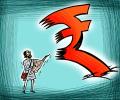
Historically, there has been no correlation between growth in bank credit to industry and lower benchmark interest rate

The combined interest payment for India's top listed companies, excluding financial and oil and gas firms, was up 15.2 per cent year-on-year during the six months ended March 2019, outpacing the change in net sales and operating profit.

More asset sales may be only way out, though most of the group companies' ratings have been downgraded and their combined market value is now a fraction of their combined debt.

The risk-reward ratio could turn adverse for foreign investors if corporate earnings disappoint by wide margins, or if crude oil prices spike in the international market, putting pressure on the rupee-dollar exchange rate.

The Hinduja Group, Mukesh Ambani, Murugappa, and the Adani groups were the other gainers in the Modi regime, while Naveen Jindal and Sun Pharma groups saw the most erosion in their m-cap in the last five years, reports Krishna Kant.

Analysts attribute this fall to the recent moderation in energy (mainly crude oil) and commodity prices, lowering of input costs for companies in sectors such as FMCG, consumer durables, and automobiles, reports Krishna Kant.
Brokerages put sell notice on Vedanta shares over the company's move to buy Volcan Investments' stake in Anglo American via subsidiary Cairn India Holdings, reports Aditi Divekar.

While the brand did step into cities such as Delhi in the last few years, it is now stitching up an expansion strategy aimed at partaking of growth in areas where consumption of ice cream remains strong.

Financial planners advise against putting capital to work by anticipating what might go up or down.

Listed realty developers saddled with unsold properties worth Rs 1 trillion

India's cash-rich promoters are not the same as the wealthiest. For example, Mukesh Ambani is the richest Indian based on his stake in Reliance Industries, followed by Premji, the Adani family of the Adani group, and Radhakishan Damani of Avenue Supermarts.

The group will be in a better position to now scale up most of its segments irrespective of government policy, but the bad news others add is its growing debt.

Mukesh Ambani remains the country's wealthiest promoter as his stake in Reliance is now worth Rs 3.25 trillion!

Average salary has grown faster than average business income for three of the last five years. This has implications in a country like India. Most people in India are self-employed, with 51.4% of the population falling in that bracket.

41 listed firms made 73 donations to gaushalas (cow shelters) and other cow-related charities over the last four years. The donations range from a few thousand rupees to a million.

Most NBFCs will have to slow down their loan growth. Some of the most leveraged will have to sell a part of their assets (or loan book) to banks to raise incremental capital. Others may have to knock on the door of their deep-pocketed parents.

The finance ministry has short listed 11 PSUs for a possible buyback of shares in the ongoing financial year

Total net debt-equity ratio improves for third consecutive year, while investment in new projects hits a 10-year low, says Krishna Kant.

27 large listed firms give double-digit hikes to top executives despite a decline in net profit.

Second-tier NBFC stocks are trading at 24.4x their trailing earnings, which is nearly twice their 15-year average of 13.9x
 © 2026 Rediff.com - Advertise with us - Disclaimer - Privacy Policy - Sitemap - Feedback - About us - Terms of use - Grievances